
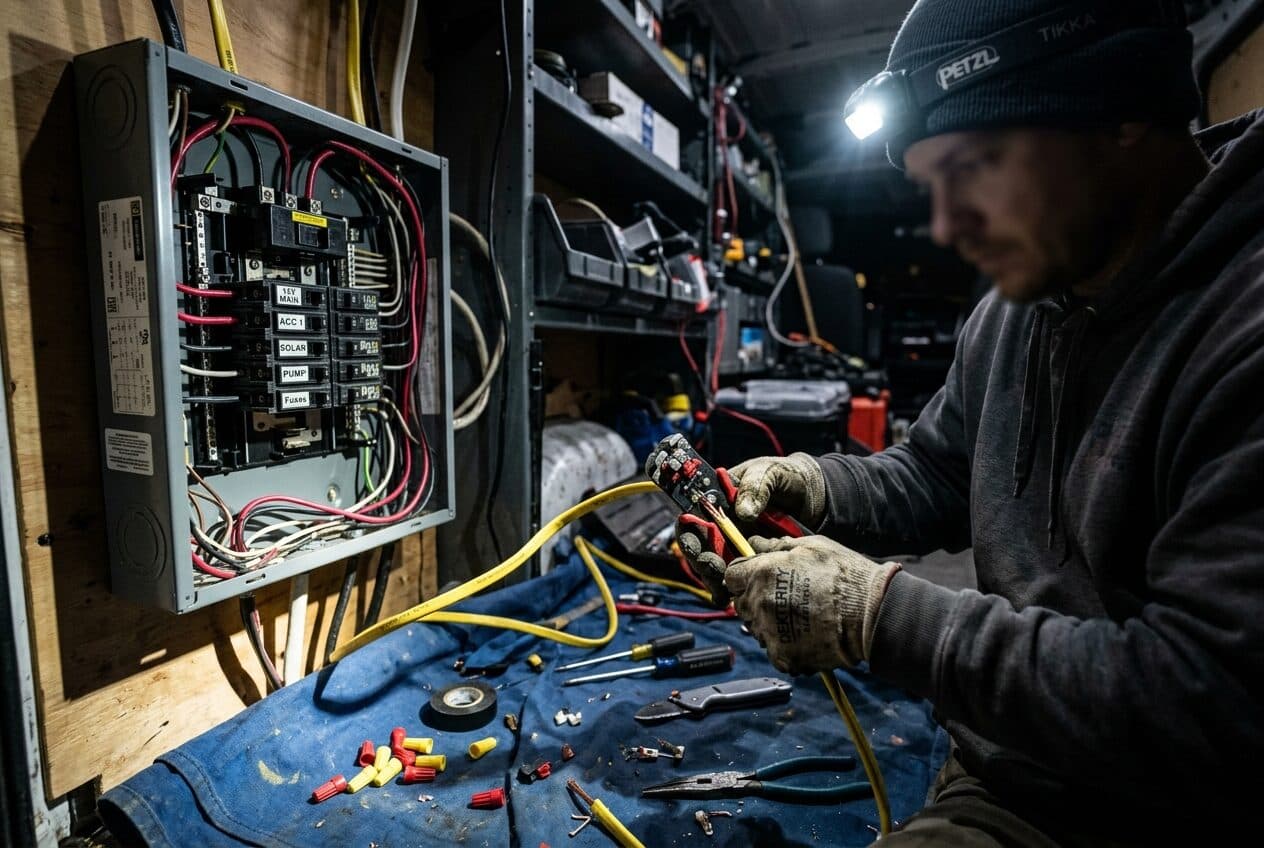
Every build thread has the same moment: forty tabs open, three conflicting wire gauge charts, and a battery sitting in the driveway judging you. 12V system wiring basics sound simple until you're the one holding the crimper. We're not electricians, and we're not going to pretend otherwise — this is what we've compiled while researching our own future build, cross-checked against what the forums, YouTube builders, and off-grid community generally agree on.
We're still early in this ourselves. That's the whole point of this pillar: technical systems, explained plainly, without the confidence somebody hasn't earned.
Why 12V Trips People Up
Household wiring feels intuitive because most of us grew up around it. Low-voltage DC systems don't behave the same way, and the intuition doesn't transfer cleanly.
- Voltage drop matters more over distance than most people expect
- Undersized wire doesn't just underperform — it heats up
- Fuses protect the wire, not just the device at the end of it
A 12V system doesn't forgive shortcuts the way a wall outlet does.
None of that is exotic knowledge. It's just knowledge most of us didn't have on day one, and neither did we.
Start With the Load, Not the Wire
The community consensus we kept running into: figure out what you're powering before you figure out how to wire it. Every fridge, fan, light, and charger has an amperage draw, and that number drives almost every other decision downstream.
Add Up Your Amp Draw
List every device, its running amps, and roughly how many hours a day it runs. That's the same exercise that shows up in the budgeting side of a build — power and money get planned the same way: in advance, on paper, before anything gets installed.
Then Size the Wire to the Distance
The forums are unanimous on one thing: longer runs need thicker wire, not the same gauge you'd use for something two feet away. A wire gauge chart cross-referenced against both amperage and cable length is the tool builders point to again and again — and we'd rather send you to a proper chart than guess at a number here.
The Parts List Nobody Explains Well
Most first-timers know they need a battery and some wire. Fewer people walk in knowing the rest of the stack:
- Fuse or breaker — sized to protect the wire, placed close to the battery
- Battery disconnect switch — cheap insurance against a dead short
- Bus bars — so you're not stacking six ring terminals on one battery post
- Proper crimp connectors — not the cheap ones from the hardware store bargain bin
Buy the crimper once. Buy it right. Every forum thread on bad connections traces back to a bad crimp.
That advice came up so often across community threads that it stopped feeling like an opinion and started feeling like a rule.
Where We Went Looking for Answers
Because none of us are certified in this, we didn't trust a single source. We cross-referenced long-running forum threads, a handful of well-regarded YouTube builders who've documented dozens of installs on camera, and manufacturer spec sheets for the actual components — batteries, inverters, chargers — since those numbers come from the people who made the thing, not from a comment section.
Where those three sources agreed, we felt confident writing it down here. Where they didn't, we left it out rather than guess.
Testing Before You Trust It
The last piece of consensus worth repeating: test the system before you build walls or panels around it. A multimeter and twenty minutes of patience catches most mistakes while they're still a five-minute fix instead of a demo-and-redo job.
- Check voltage at rest and under load
- Watch for warm wires or connectors — heat means a problem
- Confirm your fuse actually blows before something else does
Good tools don't fix bad wiring, but a properly seasoned crimper and a decent multimeter make the difference between a clean job and a rushed one — worth having before you touch the first wire, not halfway through.
A Word on Getting This Wrong
Electrical mistakes aren't like a crooked shelf. A bad connection can mean a fire, not just an inconvenience. Everything above is compiled research and community consensus — it is not a substitute for a licensed electrician, and if your build involves anything beyond a small, simple system, it's worth having a professional look at it before you rely on it.
The Long Game
Wiring a 12V system is one small piece of a much bigger project — the one where you've traded a chunk of the grid for something you understand and can fix yourself. Getting the fundamentals right the first time is what keeps that freedom from turning into a breakdown two states from home.
We're not further down this road than you. We're just documenting it as we go, and sharing what held up under scrutiny.